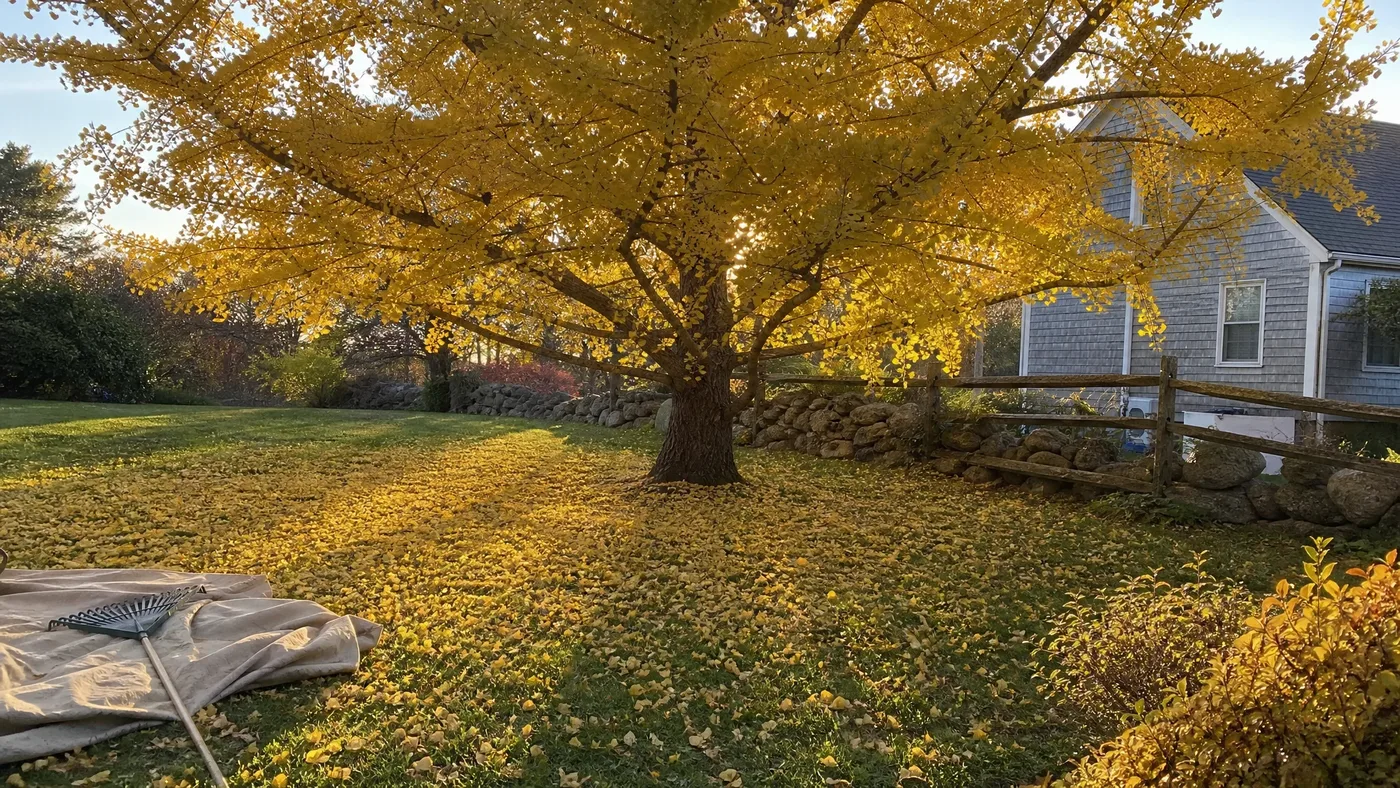
Are Ginkgo Tree Roots Invasive? System and Spread Explained
Picture a ginkgo turned upside down. The branching crown you admire in October, when the fan-shaped leaves turn golden yellow, has a mirror image underground: one main root driving downward, with side roots fanning out from it like a second, hidden crown. Most people expect the opposite from a big shade tree. They imagine a mat of surface roots that heaves sidewalks and cracks foundations.
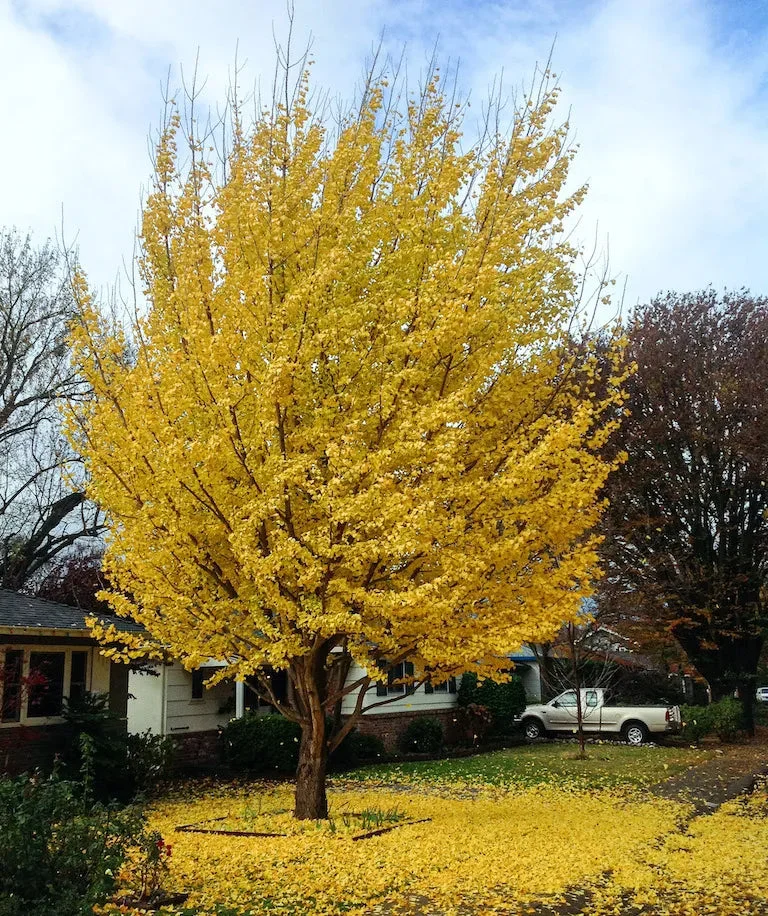
Ginkgo does not behave that way, and the reason lies in how its roots are built. University extension sources rate its roots as no problem for pavement and structures, and cities plant it along streets for that reason. A tree this size still deserves a sensible spot, though.
Below, you'll find out all about how ginkgo roots form and grow, including the terms that describe them, why a large tree still roots deep, the few situations where trouble can start, and how to place one near walls, walks and driveways.
How a Ginkgo Maidenhair Tree Builds Its Roots
Every root system starts as a single root. When a ginkgo seed sprouts, the first thing to leave the seed is one root that heads straight down. Side roots come later, branching off that central root once it has anchored the seedling. This order matters, because it sets the pattern the tree follows for the rest of its life: depth first, spread second.
The pace is slow, which is part of the story. The University of Minnesota describes the tree as usually slow-growing, especially in its early years. Roots do not outrun the crown or surge into every gap in the soil. They extend gradually, so by the time the tree is large, the roots have had decades to settle in.
From Seed to Seedling
In the first seasons, the seedling spends much of its energy on that downward root and on a modest set of side roots near the top of it. Above ground you see a thin, upright stem with a few leaves. Below ground, the tree is quietly building the anchor that will hold a very tall trunk upright in wind.
Roots in a Nursery-Grown Tree
A tree bought in a container has a different start than a seedling in open ground, because the pot limits how the roots can grow. Ginkgo is easily transplanted, and that tolerance is what makes container trees work so well. Our container and bonsai guide covers what happens when a ginkgo stays in a pot for good.
When you plant one, the goal is to give the roots loosened ground to grow into, so the main root can resume heading down. A tree whose roots are left circling in the pot shape will keep that habit for years, which is why we always suggest teasing out any wrapped roots before the tree goes into the ground.
Taproot, Laterals, and Other Terms Defined
Root talk gets confusing because people use the same word for different parts. The simplest way to sort it out is to walk from the deepest part of the system up to the surface. Each of these terms describes a job, not just a location, and knowing the jobs makes the rest of this guide easier to follow.
- Taproot. The thick central root that grows straight down from the base of the trunk. It anchors the tree and reaches soil moisture below the zone where most lawns and plants draw water.
- Lateral roots. The woody side roots that branch off the taproot and the trunk base and run sideways. They add stability and carry the thinner roots outward.
- Feeder roots. The fine, short-lived roots at the tips of the laterals. They do the actual absorbing of water and nutrients, and they live mostly in the upper soil where air is available.
- Root plate. The disc of roots and soil around the base of the trunk that holds the tree upright, much like the base of a lamp. A tree that falls in a storm usually tips this plate out of the ground.
Put together, the taproot works like a mooring line, while the laterals and root plate spread the load sideways. Ginkgo is practically pest-free and resistant to storm damage, which fits a tree that is well anchored at the base.
Notice that only the feeder roots live near the surface. They are thin and soft, and they are not the roots that lift concrete. The roots that do damage are thick, woody, and close to the surface, and a ginkgo keeps its thick roots deeper.
Why a Big Ginkgo Maidenhair Tree Still Roots Deep
The assumption goes like this: a tree that tall must have equally big roots just under the grass. Size above ground does not predict where roots sit, though. The species reaches 50 to 80 feet tall and 30 to 40 feet wide, and almost all of that bulk is trunk and branches. The root system is built for anchoring and steady supply, not for racing across the surface.
The sources agree on the practical result. UF/IFAS simply lists the roots as not a problem, and it adds that the tree is adapted as a street tree, even in confined soil spaces. It is also listed for sidewalk cutouts, the small tree pits cut into pavement, which is about the toughest test a root system can face.
The advice you hear most often is to keep any large tree far from every hard surface, and for many species that is sound. For ginkgo it overshoots. It is an excellent choice for urban settings, streetscapes and walkways, so a blanket rule meant for fast, shallow-rooted trees would waste good planting space.
One of the most common questions we get is whether a ginkgo will do to a patio what a silver maple does. Our answer is no, and the slow growth helps, since the species is slow growing. Slow growth means slow root expansion, with no sudden year when the roots outgrow their space.
Where Could Roots Ever Cause Trouble?
No tree is entirely free of root issues, and a guide that said so would not be honest. The trouble spots for ginkgo are rarely the tree itself. They come from the soil conditions or the construction around it, and they are easy to anticipate once you know what the roots are trying to do: find water, air and room.
The table below sets out the situations we would watch for and what we suggest in each.
| Situation | What the roots do | What we suggest |
|---|---|---|
| Compacted soil | Stay in the loosest layer they can find, often nearer the surface | Loosen a wide planting area before planting |
| Shallow hardpan or clay layer | Run sideways because they cannot push down | Break up the layer at planting, or choose another spot |
| Utility trenches | Follow the loose backfill like a highway | Keep the trunk well away from open trench lines |
| Leaking pipe or drain | Seek the moisture and enter through weak joints | Repair leaks first and check local rules for setbacks |
Compacted Soil and Hardpan
Ginkgo tolerates most soil, including compacted and alkaline, so the tree will survive hard ground. Survival is not the same as ideal rooting, though. In a tight or layered soil the roots take the path of least resistance, which can mean more sideways growth than the tree would otherwise make. Our soil guide explains how to prepare ground like this.
Trenches and Buried Lines
Roots do not break into healthy pipes. They find joints that already leak, because that is where water and air are. A ginkgo near a septic system or an old clay sewer line is no different from any other tree in this respect, so repair a known leak before you plant, and ask your local extension service or building department about setbacks for drain fields. We treat these as site questions, not ginkgo questions.
Placing a Ginkgo Maidenhair Tree Near Foundations and Walks
With the mechanism clear, placement becomes a matter of measuring the crown, not the roots. The sources do not give a root setback in feet, and we will not invent one. What we tell customers is to plan the distance from the structure around mature crown width, since branches and shade are the part you will actually live with.
The width figures vary, from 30 to 40 feet up to a spread of 50 to 60 feet from UF/IFAS. As a working rule, we suggest leaving at least half of the crown width between the trunk and the wall. That is roughly 15 to 20 feet on the narrower figure and 25 to 30 feet on the wider one. Our size and growth rate guide shows how fast the tree gets there.
A Simple Placement Check
Before you dig, work through these steps. They take an afternoon, and they settle nearly every placement question.
- Decide whether you are planning for the narrower or wider crown figure, and use the wider one if the space is tight and the tree is going to stay for decades.
- Lay a garden hose on the ground in a circle with that radius, centered on the planned trunk.
- Check the circle against the house, power lines, septic tank and drain field, and any buried utilities you have located.
- Look at the soil inside the circle for compaction or standing water, and fix those before planting.
- Plant following our planting guide, with a wide hole that lets the roots spread into loosened ground.
Sidewalks and driveways are more forgiving than walls and roofs. Because the tree has a record as a street tree and in tree pits, a ginkgo can sit closer to pavement than most shade trees can, as long as you leave the trunk room to thicken. For more ways to use the space, see our landscape design ideas.
Give the Crown Space and Trust the Roots
Ginkgo roots are not invasive in the way most people fear. The tree sends a main root down first, adds side roots slowly, and keeps its thick structural roots well below the surface. The situations that cause trouble, such as compacted ground, trenches and leaking lines, come from the site, and you can plan around all of them.
So the real planning job sits above ground, in crown width. Choose a spot where the branches have room to reach 30 to 60 feet across, keep the trunk clear of buried lines, and the roots will rarely need a second thought.
Ginkgo Maidenhair Tree
Nursery-grown Ginkgo Maidenhair Tree in sizes from 1 Gallon Container 1-2' Feet Tall, shipped to your door.
From $80.55
Shop Now →Ginkgo roots stay well behaved on our farms, where the trees get full sun to partial shade and moist, well-drained ground. Our own growers raise and pack each top-quality tree, so the roots you read about here arrive healthy and undisturbed. Whenever you have found the right spot, choose a Ginkgo to plant in your own garden.