How to Identify a Ginkgo Tree by Its Leaves and Bark
Press a leaf flat on a desk and find the notch at its top edge before you read anything else. That small split, where the fan dips toward the stalk, settles more ginkgo identifications than any other single feature. It matters most in October and November, when the canopy turns yellow, leaves pile up underfoot, and customers bring us bags of them along with photos of trunks and twigs.
This article talks about how to identify a ginkgo by its leaves, bark, twigs and seeds, and answers the questions customers ask us most. Read on to learn how to read the leaf and its veins, match bark to the age of the tree, check bare twigs in winter, tell male trees from female ones, and rule out the look-alikes. Work through the checks in order, because a female tree planted by mistake drops foul-smelling seeds.
Start With One Leaf in Your Palm
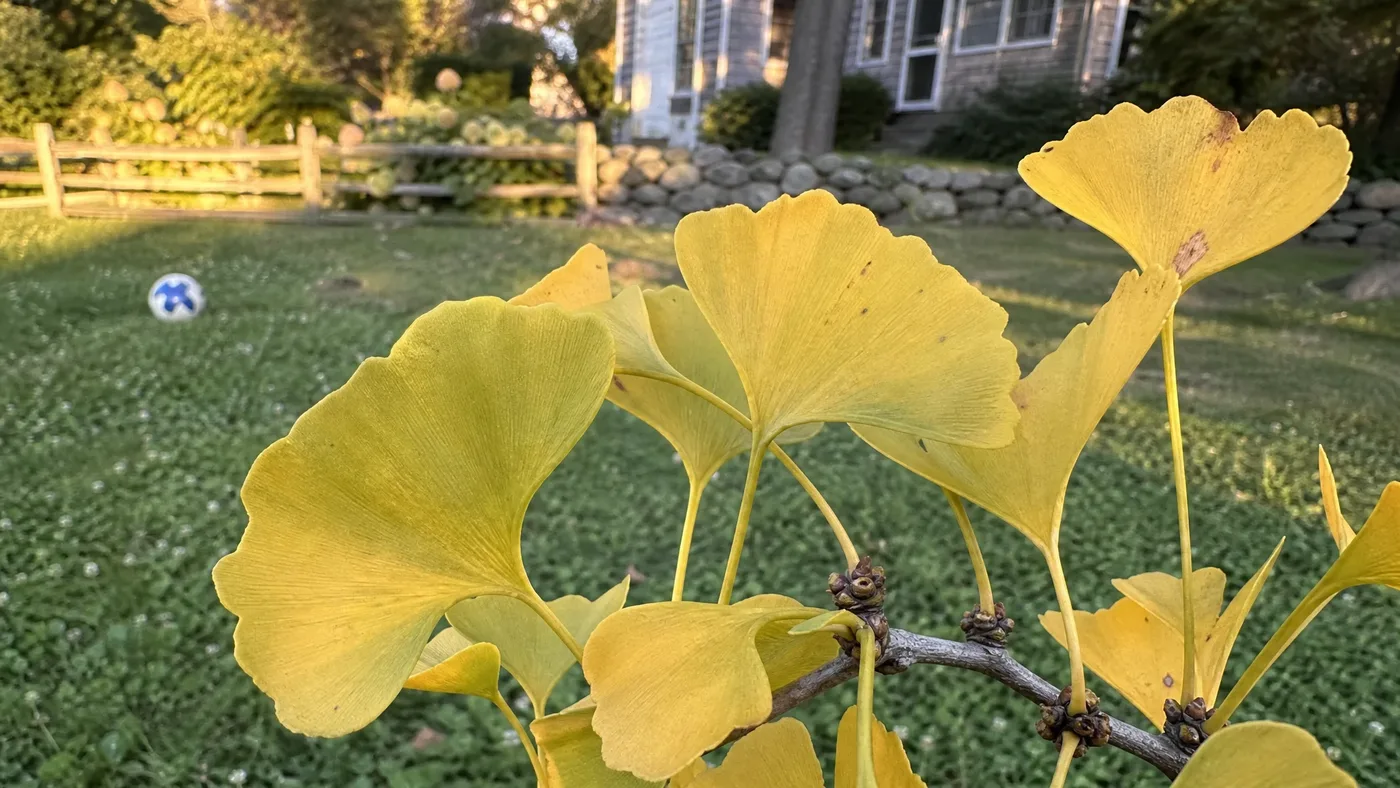
Pick a leaf from the middle of a branch, not from a base sprout or the very tip, and lay it in your palm with the stalk pointing at you. A ginkgo leaf is 2 to 3 inches long, emerald green and fan-shaped, and it widens from a thin stalk the way a hand fan opens from its handle. The species name biloba is Latin for "two-lobed," and the notch in the top edge is the reason.
Read the leaf in this order:
- Confirm the fan outline. The blade should be wider than it is long, with the stalk at the narrow end and no point at the tip.
- Find the notch. Look along the outer edge for a dip near the center, shallow or deep.
- Check the arrangement on the twig. Leaves sit alternately along new shoots, not in opposite pairs.
- Look for clusters. On older wood, leaves bunch in groups of three to five at the end of short knobby stubs.
When the Notch Is Missing
A missing notch does not rule the tree out. Leaves on older spurs often show only a shallow dip or none at all, so pick three or four more leaves from different branches before you decide. Leaves on fast-growing shoots tend to split deeper into two clear lobes, and that is normal too.
Here is the rule we use. If the fan outline and the stalk are right, keep going and let the veins decide. If every leaf has a single center line running up the blade, stop. That is another tree.
A Hand Lens Shows the Forked Veins
Hold the leaf up to a window or the sky and look at the veins with a 10x hand lens, or switch your phone camera to macro and photograph the backlit blade. In a ginkgo, fine veins start at the base of the blade and fan outward in parallel lines. Each one splits into two, then splits again. The botanical term is dichotomous venation, and that is exactly what a ginkgo leaf has.
What matters is what you do not see. There is no midrib, no single thick vein with smaller veins branching off it, and no net of veins joining back together. Run your fingernail from the stalk to the notch. On a ginkgo it never rides a raised center rib. The table gives the if-this-then-that read for what you see under the lens.
| What you see | What it means |
|---|---|
| Parallel veins that fork in two and spread toward the rim | Ginkgo. Move to the bark check. |
| One thick center vein with side veins branching off | Not a ginkgo. The tree has a midrib. |
| Several main veins radiating from one point at the stalk | Not a ginkgo. This is palmate venation, typical of maples. |
| A web of tiny veins that reconnect | Not a ginkgo. Its veins never rejoin into a net. |
If the leaf is torn or dried out and the veins are hard to follow, test a fresh leaf from the same branch. A crisp leaf in good light gives a clear answer in seconds. Backlighting matters more than magnification, so take the leaf to a window before you buy a lens.
Reading Ginkgo Maidenhair Tree Bark at Every Age
Bark changes so much with age that a single photo of a trunk can mislead you. Ask how big the tree is first, then match what you see. The species can reach 50 to 80 feet tall, but it is rated as slow growing. That means the early bark stages last longer than most people expect.
Young Stems and Saplings
Young trunks and branches are smooth and lighter in color, often pale gray, and they show little ridging. At this stage the bark alone cannot confirm a ginkgo. Lean on the leaf, the veins and the spur shoots. If the tree is a sapling with leaves on it, those are all you need.
Middle-Aged Trunks
As the trunk thickens, shallow vertical furrows appear and the bark darkens. Look for ridges that run mostly up and down, with pale gray-brown fissures between them. If the furrows spiral or flake off in plates, you are probably not looking at a ginkgo.
Old Trunks
Mature bark is gray-brown and ridged, with deep, rough furrows that give the trunk a corded look. On a large tree, expect a straight central trunk with branches that hold a narrow outline for years before the crown broadens. If you see the corded ridges and a straight trunk, go on to the twigs.
Spur Shoots Along the Twig
Bare twigs give you the most reliable check between November and April. A ginkgo grows two kinds of shoots: long shoots that extend the branch each year and short shoots, or spurs, that are reproductive. Spurs look like stubby, wrinkled pegs sticking out sideways from the branch, ringed with tight growth lines from many seasons of leaf drop.
Run your thumb along a two- or three-year-old branch. On a ginkgo you should feel a series of these knobs spaced along the wood, each one only a fraction of an inch long. In leaf, each spur carries the cluster of three to five fans described earlier. Out of leaf, the spur alone tells you what you have.
In our rows, the spurs are the first thing we look at when a customer sends us a winter photo with no leaves in it.
Use this if-then check. If the twig is smooth with buds at regular intervals and no knobs, it is not a ginkgo. If you see stout pegs, you are close, and one more check will finish it. Be careful on the youngest wood, since the current year's long shoot has no spurs yet. Look at older wood a foot or two back from the tip.
Pollen Cones and Fruit on a Ginkgo Maidenhair Tree
Reproductive structures are the last confirmation, and they depend on the tree's sex. The species is dioecious, with separate male and female trees, and it produces no flowers at all. A tree that shows none of these structures may simply be too young or the wrong sex for the season, so treat their absence as neutral.
Male Trees in Spring
Male trees produce small pollen cones, and the species is listed as blooming in spring. Look for short, catkin-like cones dangling from the spurs just as the first leaves open. They are a good sign of a ginkgo, and they cause none of the mess a female tree does.
Female Trees in Fall
Female trees bear ovules at the end of a stalk, which later become plumlike, yellow-orange seeds. Strictly, a ginkgo is a gymnosperm and makes no true fruit. The outer pulp is foul-smelling when ripe, and the inner shell is hard, smooth and cream colored. The University of Minnesota notes that the odor is strong and unpleasant. Your nose will confirm the ID before your eyes do.
Handle fallen seeds with gloves, since the pulp juice can irritate skin. For the full story on telling the sexes apart, read our guide on male versus female ginkgo trees, and for cleanup see ginkgo seeds, smell and mess.
Sorting a Ginkgo Maidenhair Tree From Look-Alikes
Several plants get mistaken for a ginkgo at a glance, mostly on leaf shape or fall color. The common name points at one of them: the leaf resembles the leaflets of maidenhair fern. Use the single feature in the table to rule each one out, and do not weigh them against each other.
| Look-alike | What it shares | Feature that rules it out |
|---|---|---|
| Maidenhair fern | Small fan-shaped leaflets | It is a low, soft plant with wiry dark stalks, not a woody tree with bark. |
| Tulip tree | Large, distinctive leaf shape, yellow fall color | Each leaf has a midrib with side veins, and the blade is lobed rather than fan-shaped. |
| Japanese maple | Hand-like leaf, strong fall color | Toothed lobes with veins radiating from one point, and leaves in opposite pairs. |
| Katsura | Rounded leaves, yellow fall color | Heart-shaped blades with a few main veins, not forking fans. |
The pattern is always the same. Every look-alike fails on the veins or the arrangement, which is why the lens check comes right after the leaf outline. A ginkgo is also an ancient lineage with no close relatives among today's trees, a story we cover in our living fossil history.
If you are trying to choose between a ginkgo and a Japanese maple for a planting, our comparison guide covers that decision. For identification, though, the maple fails the vein test at once, so do not let a similar fall color talk you out of the lens.
When Season or Light Fools Your Eye
The same tree looks different in April, July and November, and a few conditions can make a ginkgo seem wrong. Adjust for the season before you doubt the leaf.
New Growth and Shade Leaves
Spring leaves are small, soft and folded, and the fan does not open fully for a few weeks. By summer the leaves are a deep green and reach full size. Leaves grown in shade tend to be larger and thinner than sun leaves, and often more deeply split. Check the veins, not the size.
Fall Color and Winter
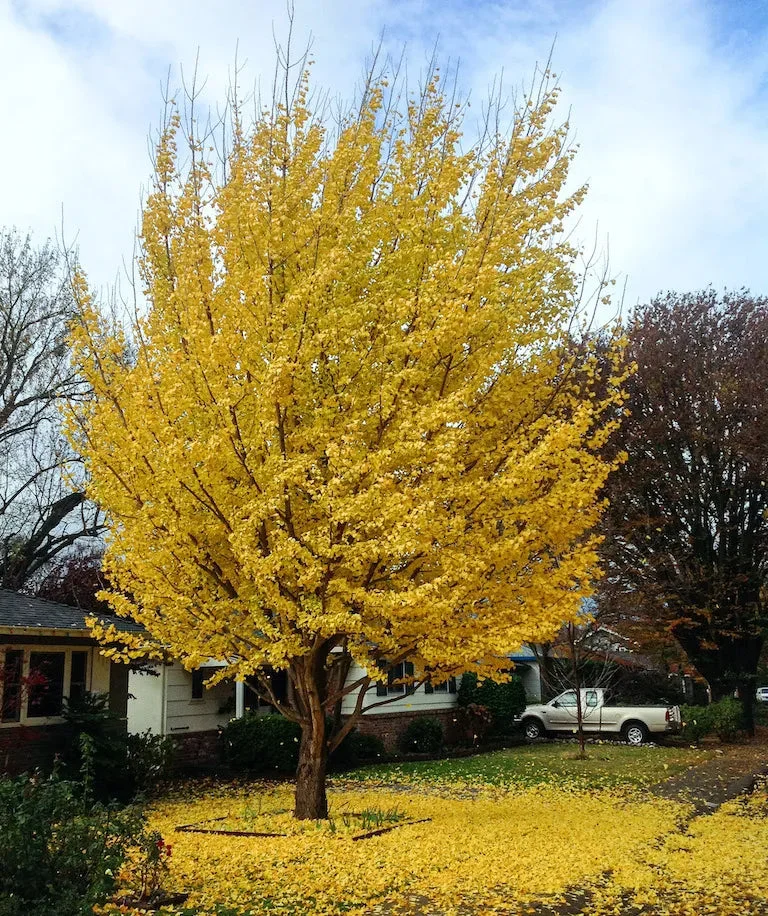
In fall, the leaves turn bright yellow, and many ginkgos drop them within a short stretch. Do not treat yellow as proof, since other trees turn the same color. Our guide on ginkgo fall color explains the pattern. Once the leaves are down, use bark and spur shoots, and pick up a fallen leaf from the ground to run the vein check indoors.
Damaged Foliage
Wind tears, hail or heat scorch can chew the outline of a leaf and hide the notch. When that happens, look at the veins on the intact edge. Forking lines that never form a midrib are still a ginkgo. A ginkgo is rarely troubled by pests, so a ragged leaf usually points to weather rather than bugs.
Ginkgo Maidenhair Tree Confirmed in Four Checks
Run the checks in order. First, a fan-shaped, two-lobed leaf on a thin stalk, in clusters of three to five on older wood. Second, forking veins with no midrib under a lens. Third, gray-brown ridged bark on an older trunk, or smooth bark on a young one. Fourth, stubby spur shoots on bare twigs, with pollen cones or plumlike seeds as a bonus.
If all four checks pass, it is a ginkgo. If one fails, go back to the leaf, pick a fresh sample from another branch and start again, because most wrong calls come from a single odd leaf.
Ginkgo Maidenhair Tree
Nursery-grown Ginkgo Maidenhair Tree in sizes from 1 Gallon Container 1-2' Feet Tall, shipped to your door.
From $80.55
Shop Now →Ginkgo grows best on our farms in full sun, planted in soil that stays moist but drains well, which is how the fan-shaped leaves and ridged bark you just learned to read develop cleanly. Ours is a small business, and everything we sell is a top-quality plant raised in our own rows. When you have identified your tree and want one for your yard, we would love for you to browse our Ginkgos.