Do Ginkgo Trees Flower? Bloom Time and Pollen Cones
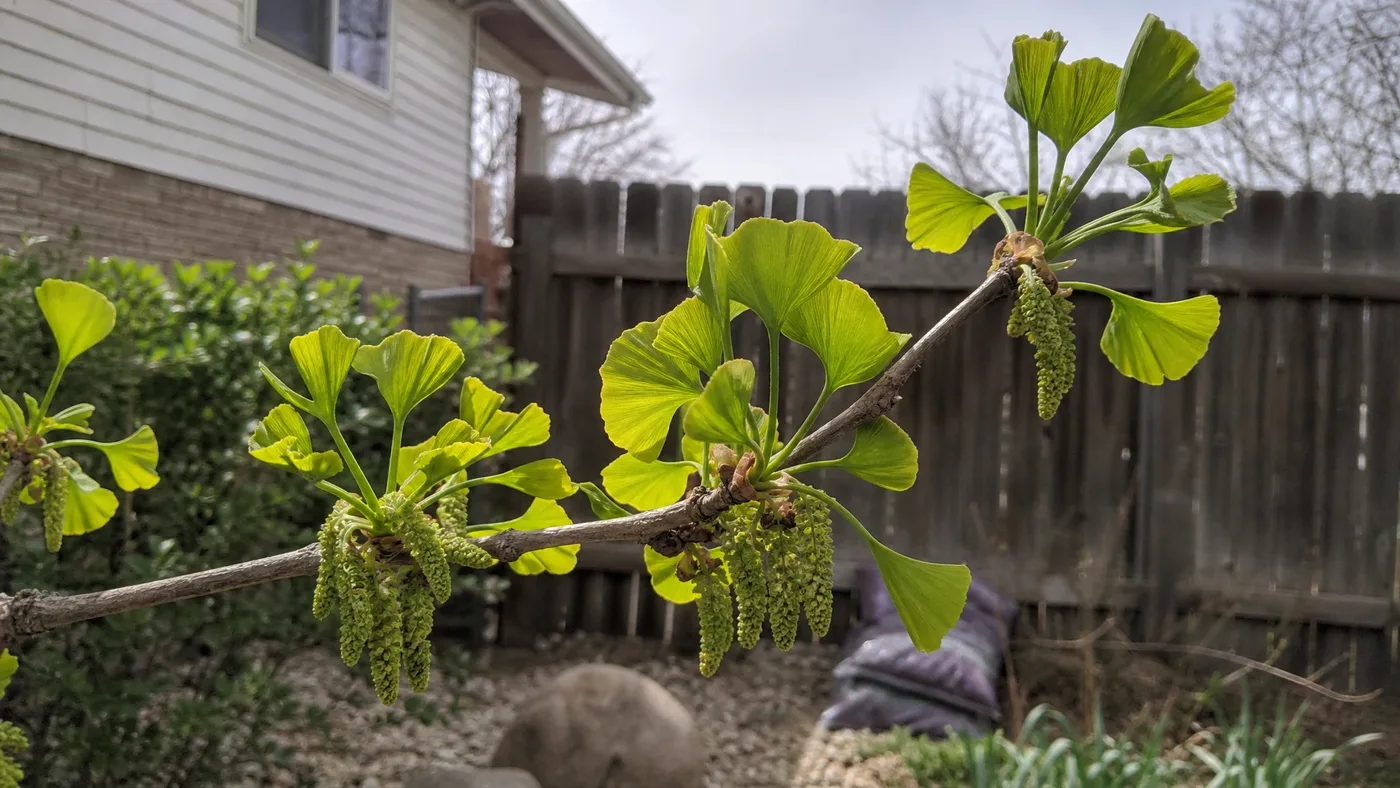
Most people assume every tree blooms, so they wait for a ginkgo to put on a show and decide theirs never did. In April we see something else. Rub a spring pollen cone between your fingers and you get a green, faintly resinous smell. You are holding something that looks like a flower and is not one.
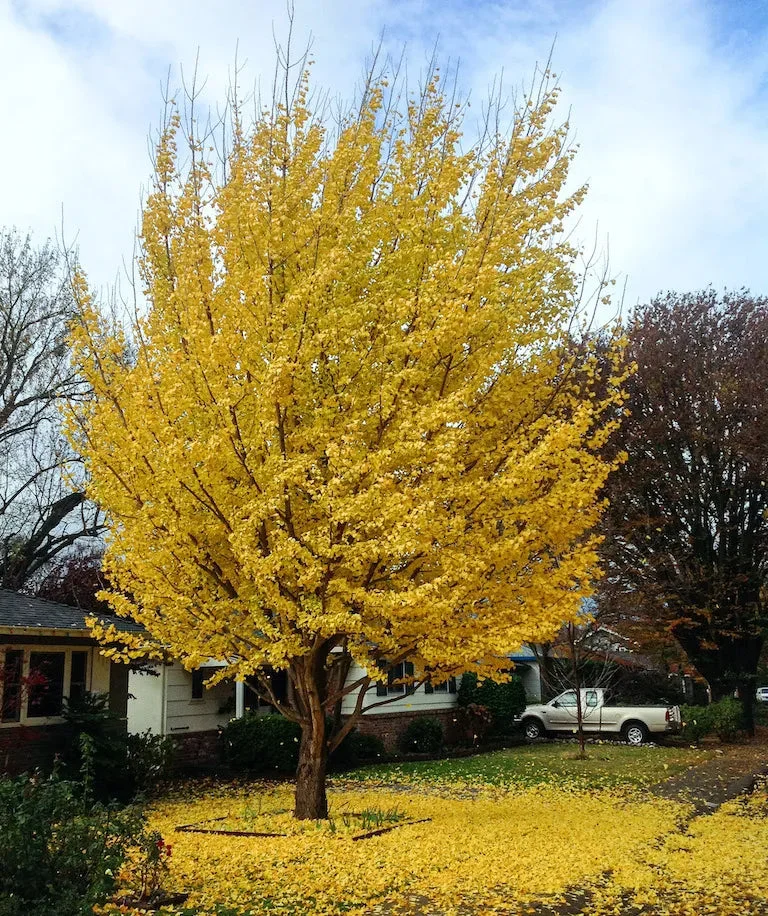
Ginkgo is a gymnosperm, a tree that makes cones and ovules instead of petals, and it comes as separate male and female trees. That split decides what you see, when you see it, and why the neighbor's tree can look bare year after year.
Below, you'll find out all about ginkgo spring cones, including how they look on a male in a tight bed, what wind does to them on an open corner, why a potted young tree stays blank, and how to read the sex of a tree that has never "bloomed."
A Narrow Side Bed and Its Male Ginkgo Maidenhair Tree
Picture a side bed between a walkway and a fence, wide enough for one tree and not much else. A male ginkgo is the tree we would put there, and spring is when it pays you back for the close view. Between April and May, small cones dangle from the short spur shoots just as the fan-shaped leaves unfold. At arm's length, you can inspect every one of them.
What the Cones Look Like Up Close
The male structures are about 1 inch long and catkin-like, with numerous stamens loosely arranged along a central axis. They hang in small clusters, soft and slightly bumpy, and they shed pollen when ripe. Crush one and you get that green, resinous scent. The leaves around them are still small and bright, so the cones show up well against the twigs.
Nothing about them is showy, and that is part of the charm. You will not find petals, nectar or a color meant to draw bees. The tree has no need to advertise, because its pollen travels on air. Lean in close in the first warm week, and a plain-looking branch turns out to be full of tiny detail.
Why a Male Belongs in a Tight Spot
A narrow bed usually sits beside foot traffic, and that settles the sex question. Female trees drop plum-sized seeds in fall, and the fruit-like pulp contains butanoic acid and smells rancid on the ground. Walkways, steps and parked cars all get that smell, which is why cities plant males. Our male vs female ginkgo guide goes deeper on the trade-offs.
Size deserves an honest word too. A mature ginkgo reaches 50 to 80 feet in height with a spread of 30 to 40 feet, and some trees stay nearer 50 to 60 feet. Young ginkgos are slow and fairly slim in their early years, so a tight bed works for a long time. Still, plan for the sky above it and the walls beside it.
We grow Ginkgo for sale, and the first question to ask any seller is whether the tree is a known male.
Windy Corner Lot With a Ginkgo Maidenhair Tree
A corner lot catches every gust, and a ginkgo handles that better than most trees. The species is practically pest-free and resistant to storm damage. Wind also happens to be the tree's pollination method. A male on an open corner releases pollen into moving air, and a female downwind can catch it on her ovules without any insect involved.
What Wind Does to the Cones
The cones are soft and short-lived, and a hard April blow can strip or shred some of them before they finish. Do not read that as a failed season. A mature male carries a great many, and the ground beneath it may look littered with spent cones after a gusty week. A sheltered spot lets you enjoy them longer, but the tree is not harmed either way.
If you are tempted to stake a young tree against the wind, think twice. A ginkgo planted at the right depth anchors itself and rarely needs help.
What a Female's Ovule Stalks Look Like
Females do not make catkins at all. The female structures are ovules at the end of a stalk, and Oregon State adds that the stalk is long, solitary, roughly 1.5 to 2 inches, with two opposing ovules at its tip. Look for a thin green thread holding a pair of tiny bead-like knobs, tucked among the new leaves.
They are easy to miss. We often see customers notice them only after the seeds ripen in fall, when the same stalks carry yellow-orange, plum-like seeds with foul-smelling pulp. If you want the full story on those, our seeds and fruit guide covers cleanup.
How Exposure Shifts the Timing
Spring runs on temperature, so an exposed corner that stays cold and breezy tends to open its cones a little later than a tree sheltered against a south wall. The window is April to May either way. Your own climate moves it further, so ask your local extension service for typical dates, then check the branch tips every few days.
A late cold snap can also slow things down. The leaves and cones come out together, so if the leaves are still tight buds, the cones are not far behind and not worth looking for yet.
A Pot on a Hot Deck With a Young Ginkgo
A young ginkgo in a container on a sunny deck is a pleasure for its leaves and a reliable disappointment for its cones. A tree this age is simply not old enough. The fan-shaped foliage, the pot and the tree's shape are the show for now, and the cones come only after the tree matures. That wait is long, and it is worth knowing before you start watching for them.
Why It Shows Nothing for Years
Oregon State notes it may be twenty or more years before a seedling flowers and sets seed. That is the number to hold onto. A potted tree grown from seed may go decades without a single cone, and a tree that stays cramped in a small container tends to grow even more slowly.
Because ginkgo is slow in its early years, the pot also keeps the tree small for a long while. Cones, when they finally come, form on the short spurs along older wood, so a whippy young stem will not carry them yet. Light pruning and patience are the plan for now.
How Heat Nudges Timing
A deck bakes. Reflected heat from boards and railings warms the pot and the branches, so leaf-out and any cones can come a little ahead of a tree in open ground. Heat cannot make a juvenile tree mature, though. It only moves the calendar for a tree that is already old enough, and it does nothing to shorten the years of waiting.
Drought tolerance is rated high for the species, but a pot is not open ground. Roots in a small container dry out fast under direct sun, so check moisture often through summer. For pot size, drainage and winter care, see our container and bonsai guide.
The Backyard Neighbor Who Swears Theirs Never Bloomed
One of the most common questions we get comes from a neighbor's yard: "My ginkgo has never flowered. Is it sick?" Almost always, no. A ginkgo never makes true flowers, so there is nothing to wait for. NC State says it plainly: ginkgo is a gymnosperm and does not produce flowers, and the trees are dioecious, with separate male and female plants.
Look for Cones and Stalks Instead
The tree may well have been making these structures every spring without the owner noticing, because they are small and green. Here is how to check:
- Go out in April or May, when the first leaves are opening.
- Look at the short, knobby spur shoots along the older branches, not the long twigs.
- Hold a branch tip up to the light and scan for dangling, catkin-like cones about an inch long.
- If you see none, look for thin stalks carrying two tiny knobs.
- Repeat every few days for two weeks, since the window is short.
What It Reveals About Sex
If you find cones, the tree is male. If you find paired-ovule stalks, or seeds in fall, it is female. If you find neither on a tree that is clearly mature, check again next year, because a cold or windy spring can make a cone season easy to miss. A tree that is still young is a different case, and a sprawling mature tree with no seeds in fall is very likely a male.
A common piece of advice is to wait for a ginkgo to flower to learn its sex. We would not. If the tree came as a seedling, the wait could run past twenty years, so buy a tree sold with its sex known and skip the guesswork.
Ginkgo Maidenhair Tree Spring Cones Without the Fuss
Every case above comes down to one calendar and one split. The calendar is spring, most reliably April to May, when the new leaves are small and the branch tips are easy to inspect. The split is male or female. Once you know both, you know where to look, what you are looking at, and how much patience a young tree is asking of you.
This table sums up what you will see, depending on the tree in front of you.
| Tree | What appears | When to look |
|---|---|---|
| Mature male | Dangling, catkin-like pollen cones about 1 inch long | April to May |
| Mature female | Thin stalks with two tiny ovules, then seeds in fall | Spring, and again in fall |
| Young potted tree | Leaves only | Nothing yet |
| Seedling-grown tree | Leaves only, often for 20 or more years | Keep checking each spring |
If you are shopping, our buying guide covers sizes and what to ask. Leave the idea of "bloom" at the door. A ginkgo's spring display is quiet, and you only see it when you lean in.
Go Look at Your Ginkgo Maidenhair Tree This Spring
A ginkgo does not bloom, because it never makes flowers. It makes pollen cones on males and paired-ovule stalks on females, usually in April to May, and a young or seedling-grown tree may show neither for 20 or more years.
Late in April, walk out to the branch tip. Fresh leaves are fanned out like tiny green hands, small cones are swaying on their threads, and a resinous green scent is on your fingers. Go and look this spring.
Ginkgo Maidenhair Tree
Nursery-grown Ginkgo Maidenhair Tree in sizes from 1 Gallon Container 1-2' Feet Tall, shipped to your door.
From $80.55
Shop Now →We grow our Ginkgo on our own farms, in full sun and well-drained soil. Every Ginkgo we ship is potted and packed by our own growers so it arrives ready to plant. Pick out a tree for your own garden in our shop.